25000mAh Detachable Solar Power Bank Technical Review
25000mAh Detachable Solar Power Bank
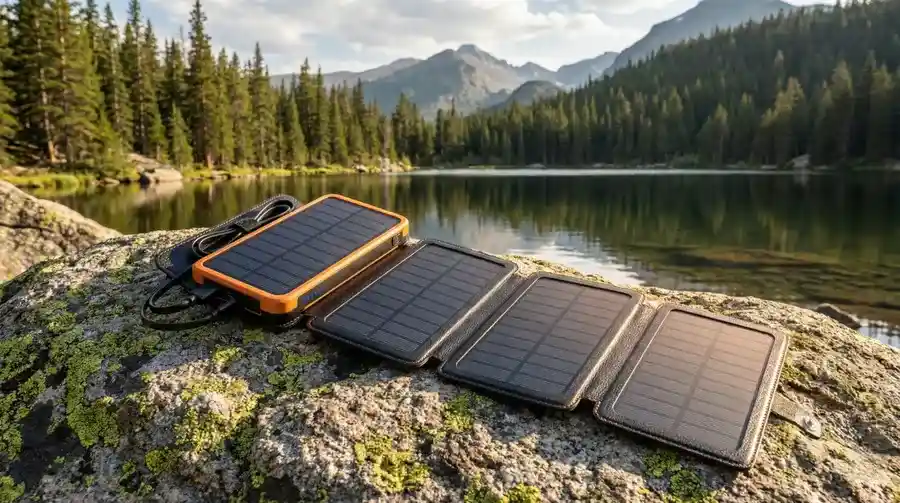
The 25000mAh Detachable Solar Power Bank, manufactured under brands such as Goodoo and Addtop, represents a modular approach to portable energy storage. Designed for off-grid environments where weight-to-power ratios are critical, this product integrates a high-capacity lithium-polymer battery with a foldable solar panel battery pack system. Unlike fixed-panel chargers that offer limited surface area, this device utilizes four monocrystalline panels to increase solar collection potential while maintaining a footprint suitable for backpack attachment. It exists in the market to bridge the gap between small-scale personal power banks and larger, less portable solar generators, targeting hikers and emergency preparedness scenarios.
Pros
- Modular panel design allows for weight reduction when solar charging is not required.
- High-capacity 25000mAh reservoir provides multiple recharge cycles for standard smartphones.
- Dual USB-A output ports support simultaneous charging of two mobile devices.
- Integrated magnetic and snap-button attachment system ensures secure panel connection during transit.
- Built-in LED array provides functional illumination for low-light camping environments.
Cons
- Solar charging rates are insufficient for rapid replenishment of a depleted 92.5Wh battery.
- Total weight increases significantly with all four panels attached, impacting ultralight trekking.
- Charging inputs are limited to Micro-USB, lacking the faster PD protocols found in modern alternatives.
- Passive thermal management is challenged when the battery is exposed to direct sunlight for solar harvesting.
Technical Specifications
| Parameter | Specification |
|---|---|
| Battery Capacity | 25000mAh / 92.5Wh |
| Battery Type | Lithium Polymer |
| Solar Input (Total) | 6.0 Watts (Max) |
| Panel Configuration | 4 x 1.5W Monocrystalline Panels |
| USB Output 1 / 2 | 5V / 2.1A (Max) |
| Input (Micro-USB) | 5V / 2.0A (Max) |
| Dimensions (Folded) | 6.1 x 3.3 x 1.3 inches |
| Total Weight | Approx. 1.18 lbs (535g) |
Design and Structural Analysis
The primary chassis of this 25000mAh solar portable charger is constructed from a combination of ABS and polycarbonate (PC) plastics, chosen for impact resistance and weight optimization. The external surface features a matte texture to improve grip in humid or wet conditions. The "detachable" nomenclature refers to the four-panel solar array, which connects to the main battery unit via a dedicated electrical interface secured by high-strength magnets and physical snap-fasteners.
Portability is defined by the folding mechanism of the panels. When collapsed, the unit occupies a volume similar to a thick paperback book, allowing it to fit into side pockets of standard tactical or hiking packs. The layout places all IO ports—specifically the two USB-A outputs and the single Micro-USB input—on the top edge, protected by a silicone weather-resistant flap. LED indicators on the front face communicate both the current battery SOC (State of Charge) in 25% increments and the active status of the solar charging circuit.
The integration of the panels involves a canvas-like synthetic material backing that provides the necessary flexibility for folding while maintaining structural integrity over repeated cycles. While the design is marketed as weather-resistant, the exposed electrical contact points between the detachable panel and the battery unit require protection from direct moisture ingress to prevent corrosion or short circuits.
Functional Capabilities and Safety Systems
Modularity and Solar Integration
The defining feature of this detachable solar power bank is the ability to scale the solar collection surface. In static basecamp scenarios, the full four-panel array can be deployed to capture maximum irradiance. In transit, the panels can be removed to reduce the unit's weight, transforming it into a standard high-capacity portable battery. This modularity is an essential feature for users who may only require solar replenishment during specific segments of a multi-day trip.
Power Management
Internally, the device utilizes a standard BMS (Battery Management System) designed to prevent over-voltage, over-current, and deep discharge. The 25000mAh solar portable charger utilizes a 3.7V nominal internal cell voltage, which is then stepped up to 5V for USB output. This conversion process incurs inherent efficiency losses, typically resulting in a usable capacity of approximately 16,000mAh to 18,000mAh at the 5V output stage.
Auxiliary Systems
The inclusion of a multi-mode LED flashlight serves as a non-essential but practical utility. The array supports steady-state illumination, SOS signaling, and strobe modes. However, the device lacks advanced smart features such as Bluetooth monitoring or programmable output curves, prioritizing hardware reliability over software complexity.
Performance Metrics and Practical Expectations
Solar Harvesting Efficiency
Under ideal STC (Standard Test Conditions) of 1000W/m² irradiance, the four-panel array is rated for 6W of input. In real-world environments, factors such as atmospheric haze, panel temperature, and non-perpendicular sun angles typically reduce this to 3–4W. Given the 92.5Wh capacity of the internal battery, a full charge via solar alone would require approximately 25 to 35 hours of peak sunlight. This makes solar charging a supplemental "trickle" method rather than a primary replenishment source.
Output Stability
The dual 2.1A outputs maintain stable voltage levels under moderate loads. When both ports are occupied, the total current is shared, which may lead to slower charging speeds for power-intensive devices like tablets. During sustained output, the internal temperature remains within operational limits (below 45°C) unless the device is simultaneously exposed to high ambient temperatures and direct sunlight.
High-Capacity Solar Power Bank for Camping Performance
As a high-capacity solar power bank for camping, the device excels in maintaining the charge of low-power peripherals such as headlamps, GPS units, and smartphones. Reliability is high over repeated charge cycles, though the lack of USB-C Power Delivery (PD) means that users with modern laptops or high-draw devices will find the 10.5W maximum output restrictive.
Pricing and Market Positioning
The current price range for this 25000mAh detachable solar power bank typically falls between $40.00 and $60.00 USD. The cost is driven primarily by the high-capacity lithium-polymer cell and the inclusion of the multi-panel monocrystalline array. Compared to fixed-panel solar chargers of similar capacity, which often retail for $30.00–$45.00, the price premium for the Goodoo/Addtop model is attributed to the modular panel design and the increased surface area for solar collection.
From a cost-to-performance perspective, the value lies in the flexibility of the detachable panels. While dedicated 21W solar folders paired with a separate 25000mAh power bank may offer faster charging, the integrated nature of this product provides a more streamlined, lower-cost alternative for casual off-grid use. Long-term value is contingent on the durability of the folding canvas and the stability of the cell chemistry over 500+ charge cycles.
Final Evaluation
The 25000mAh Detachable Solar Power Bank is a specialized tool for users who prioritize modularity and significant energy reserves. While it cannot replace a wall outlet for rapid charging, its ability to harvest energy in remote locations provides a necessary safety margin for off-grid navigation and communication. For those comparing this unit against other market leaders, it is helpful to view its placement among the Top 10 Solar Power Banks to understand how its 6W solar input compares to higher-wattage dedicated arrays.