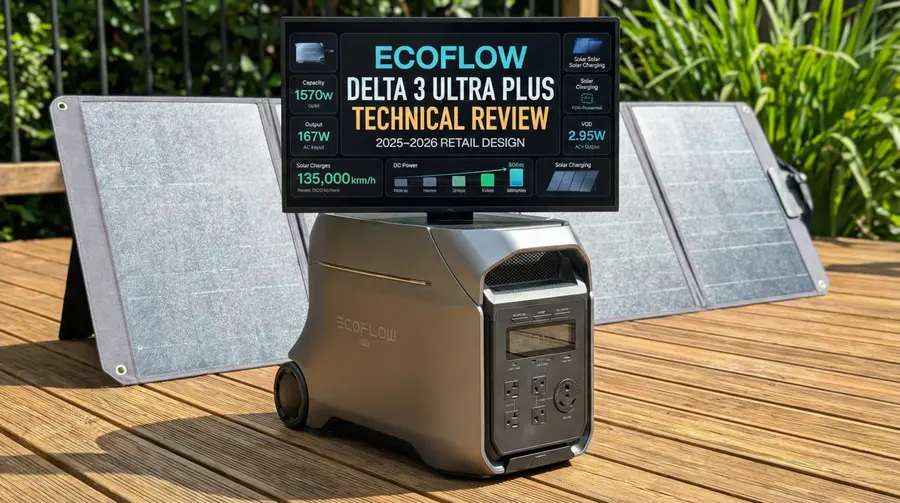
ECOFLOW Delta 3 Ultra Plus
High-Capacity Portable Power StationThe EcoFlow Delta 3 Ultra Plus is a high-capacity portable power station designed for residential backup, off-grid living, and high-demand mobile applications. As an iterative advancement in the Delta series, this unit functions as a central energy hub capable of managing significant electrical loads through integrated battery storage and sophisticated power conversion hardware. It exists in the solar market to bridge the gap between small-scale portable units and permanent home battery installations, providing a modular solution for users requiring a portable solar generator for home backup.
Pros & Cons
Pros
- High solar charging efficiency with dual MPPT controllers allowing for diverse panel configurations.
- LiFePO4 battery chemistry ensures 3,000+ cycles to 80% capacity, offering long-term reliability.
- UPS-grade switching speed (sub-10ms) provides effective protection for sensitive electronics during grid failure.
- Modular expandability allows capacity to scale with additional battery packs to meet multi-day energy requirements.
Cons
- Significant physical mass limits manual portability for a single operator.
- Cooling fan noise levels increase substantially under peak inverter loads or rapid charging.
- Cost-per-watt-hour is higher than stationary DIY battery banks of similar capacity.
Technical Specifications
| Battery Chemistry | Lithium Iron Phosphate (LiFePO4) |
|---|---|
| Base Capacity | 6144Wh (Expandable to 90kWh) |
| AC Output | 7200W (Continuous), 14400W (Surge), 120V/240V Support |
| Solar Input | 4000W Max (Dual MPPT: 11-150V 15A per port) |
| AC Charging Input | Multi-voltage support; up to 3000W Max |
| DC Outputs | USB-A, USB-C (100W PD), 12V Car Port, DC5521 |
| Dimensions | 27.3 x 13.4 x 19.2 inches |
| Weight | 181 lbs (82 kg) |
| Operating Temperature | -20°C to 45°C (-4°F to 113°F) |
Physical and Functional Design
The chassis of the Delta 3 Ultra Plus is constructed from high-impact polycarbonate and reinforced structural aluminum. This material selection is necessary to maintain structural integrity given the 181-pound dry weight of the base unit. The design utilizes a vertical stacking form factor, which minimizes the floor footprint—a critical consideration for indoor storage or deployment in cramped utility closets.
Portability is addressed through integrated heavy-duty casters and a telescoping handle. While these features facilitate movement on flat, finished surfaces, the unit's mass poses significant challenges on uneven terrain or stairs. The port layout is bifurcated: high-current AC inputs and outputs are located on the rear panel for semi-permanent installation, while lower-draw DC ports and the primary interface are situated on the front for user accessibility.
Thermal management is handled by four variable-speed internal fans. These fans utilize a pull-push configuration to move air across the inverter heat sinks and battery cells. The placement of intake vents includes dust filtration, though the unit does not carry an IP rating for water resistance, requiring sheltered operation in all environments.
Functional Capabilities
The Delta 3 Ultra Plus integrates an advanced Battery Management System (BMS) that monitors cell voltage, current, and temperature in real-time. This system includes protections against over-voltage, over-current, short-circuit, and thermal runaway. A key feature of the hardware is its ability to provide 120V/240V split-phase output directly from a single unit, eliminating the need for a secondary voltage hub when powering large appliances like well pumps or clothes dryers.
Expandability is a core attribute. The unit supports up to 15 additional LFP battery packs. This modularity allows the system to scale from a mobile power station to a comprehensive whole-home backup battery. Furthermore, the unit features integrated Wi-Fi and Bluetooth for remote monitoring via the EcoFlow application. This allows users to adjust charging speeds, set discharge limits, and view real-time solar input metrics.
Standard accessories include an AC charging cable, a car charging cable, and a DC5521-to-DC5525 cable. The ecosystem is compatible with EcoFlow's proprietary Smart Home Panel 2, which enables automated grid-to-battery switching and circuit-level management.
Real-World Performance Expectations
In practical applications, solar charging performance is highly dependent on the PV array configuration. With a 4000W maximum solar input, the unit can theoretically recharge from 0% to 100% in approximately two hours under ideal solar conditions (STC). However, factoring in atmospheric losses and typical sun angles, a high-capacity solar battery for home use of this scale usually achieves 75-85% of its rated input in clear-sky conditions.
The inverter demonstrates high efficiency during high-draw operations, with conversion losses averaging between 10% and 15%. When powering inductive loads, such as refrigerators or air conditioners, the 14400W surge capacity prevents inverter tripping during the initial compressor startup. In sustained use at the 7200W limit, thermal throttling is a theoretical risk; however, the cooling system is calibrated to maintain operational stability at ambient temperatures up to 45°C.
Reliability is anchored in the LiFePO4 chemistry. Unlike traditional NMC (Nickel Manganese Cobalt) batteries, the LFP cells in the Delta 3 Ultra Plus are less prone to degradation from high-depth-of-discharge (DoD) cycles. This makes the unit suitable for daily cycling in off-grid solar systems where the battery is frequently depleted and recharged.
Pricing and Value Analysis
The Delta 3 Ultra Plus is positioned in the premium tier of the portable power market. The current price range reflects the inclusion of a 6kW+ inverter and 6kWh of base storage. The primary drivers of this cost are the high-density LiFePO4 cells and the dual-voltage (120V/240V) inverter hardware.
When compared to entry-level 2kWh or 3kWh units, the cost-per-watt-hour is competitive, though the upfront capital expenditure is significantly higher. For users seeking an EcoFlow Delta 3 Ultra Plus review for financial justification, the value proposition lies in the unit's longevity and its capacity to replace a traditional gas generator. While DIY solar builds may offer lower hardware costs, the integrated nature, safety certifications (UL 9540A), and plug-and-play modularity of this unit justify the margin for residential and professional users.
Final Thoughts
The EcoFlow Delta 3 Ultra Plus represents a high-performance solution for large-scale energy storage requirements. Its ability to provide split-phase 240V power and support up to 4000W of solar input places it at the top of its class for technical capability. While the weight and price point are substantial, they are commensurate with the 6144Wh capacity and 7200W output. For mission-critical backup or high-demand off-grid applications, the unit provides a stable, scalable, and technically sound platform.