BioLite SolarPanel 5+ Portable Solar Charger Technical Review
BioLite SolarPanel 5+
Portable Solar Charger with Integrated Battery
The BioLite SolarPanel 5+ is a monocrystalline BioLite SolarPanel 5+ portable solar charger designed for off-grid power generation and energy storage. Positioned within the lightweight outdoor equipment market, this device targets backpackers and field researchers who require a consistent power source for mobile electronics without the weight penalty of larger arrays. The primary function of this BioLite SolarPanel 5+ portable solar charger is to convert solar irradiance into electrical energy, storing it in an internal buffer for regulated output. Unlike traditional folding panels that require external storage media, the SolarPanel 5+ integrates a small-capacity lithium-ion battery to mitigate the effects of intermittent cloud cover and provide a more stable charging current to sensitive USB devices.
Pros & Cons
Pros
- Integrated 3200 mAh lithium-ion battery provides a buffer that ensures continuous charging during transient shade or cloud movement.
- An integrated sundial and 360-degree kickstand facilitate precise alignment with the solar vector, maximizing photon capture efficiency.
- High-efficiency monocrystalline cells offer a high power-to-surface-area ratio compared to polycrystalline alternatives.
- The thin-film design and minimalist frame reduce total pack volume for space-constrained transport.
Cons
- The 5-watt peak output limits the device to small electronics; it is insufficient for laptops or large power stations.
- Battery capacity is limited to 3200 mAh, which may only provide approximately 50-70% of a modern smartphone charge depending on efficiency losses.
- Non-modular design prevents the chaining of multiple units to increase total wattage.
Technical Specifications
| Solar Input (Peak) | 5 Watts |
|---|---|
| Panel Type | Monocrystalline |
| Internal Battery | 3,200 mAh Li-ion (11.8 Wh) |
| Output (USB-A) | 5V, 1.0A (5W) |
| Input (Micro-USB) | 5V, 1.0A (For wall charging) |
| Dimensions | 257 x 208 x 24 mm (10.12 x 8.19 x 0.94 in) |
| Weight | 390 g (13.76 oz) |
| Weather Rating | IPX4 (Resistant to splashes) |
| Operating Temperature | -20°C to 45°C (-4°F to 113°F) |
BioLite SolarPanel 5+ Portable Solar Charger Design Analysis
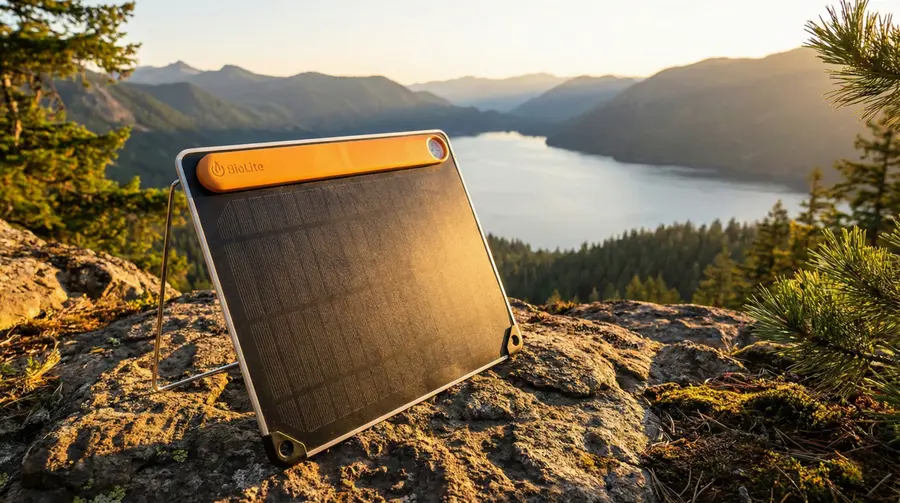
The physical architecture of the BioLite SolarPanel 5+ is characterized by its ultra-thin profile and rigid frame. The panel utilizes a sandwich construction of monocrystalline cells protected by a textured PET (polyethylene terephthalate) laminate, which serves to reduce surface reflection and improve light absorption at varied angles. This material choice prioritizes weight reduction and durability over the structural rigidity found in glass-laminated panels.
A core design element of the BioLite SolarPanel 5+ portable solar charger is the 360-degree stainless steel kickstand. Unlike static or limited-angle supports, this mechanism allows for placement on uneven terrain, such as rocks or dense vegetation. The kickstand also doubles as a mounting point for securing the panel to a backpack using carabiners or cordage. The portability and footprint of the device are optimized for standard 30-to-50 liter backpacks, fitting easily into hydration sleeves or external mesh pockets.
The control interface is localized to a small corner module containing the Micro-USB input, USB-A output, and a four-LED battery status indicator. The inclusion of an analog sundial—a simple shadow-casting pin—is a functional addition that assists the user in achieving optimal solar alignment. In solar power generation, even a 10-degree deviation from the perpendicular can result in significant efficiency drops; this visual guide allows users to maintain peak performance without specialized metering equipment.
Functional Features
The SolarPanel 5+ incorporates an Auto-Reconnect feature, which is a critical logic system for mobile device charging. Many modern smartphones will cease charging if the power supply drops below a certain threshold (e.g., during a cloud pass) and will not resume even when the sun reappears. The BioLite circuitry manages this by monitoring the solar input and automatically re-initiating the handshake with the connected device once current stabilizes.
The integrated 3200 mAh battery acts as a primary power management tool for this BioLite SolarPanel 5+ portable solar charger. It functions as a buffer, smoothing out the fluctuations inherent in solar energy. This is particularly relevant when using a portable solar charger for hiking, where movement and foliage can cause rapid changes in irradiance. The battery can be pre-charged via a standard Micro-USB port before entering the field, allowing the device to function as a traditional power bank during evening hours.
Safety systems include standard over-voltage and short-circuit protections. The IPX4 rating indicates that while the panel is resistant to splashes and light rain, it is not submersible. The ports are protected by a rubber gasket, though it must be fully seated to maintain environmental resistance. The ecosystem compatibility is limited to 5V USB-A devices, making it suitable for headlamps, GPS units, action cameras, and smartphones, but unsuitable for high-draw USB-C PD (Power Delivery) devices.
Real-World Performance Expectations
In ideal conditions—clear skies, solar noon, and perpendicular alignment—the BioLite SolarPanel 5+ portable solar charger can reach its rated 5-watt output. However, real-world performance is subject to environmental variables. Under typical hazy or partly cloudy conditions, the effective output often fluctuates between 2 and 4 watts. The monocrystalline cells are efficient, but the small surface area means that total energy harvest is time-intensive.
The internal battery requires approximately 2 hours of direct, high-intensity sunlight to reach a full charge from zero, assuming no simultaneous device output. If a device is connected while the panel is in the sun, the circuitry prioritizes the external device. Heat management is a factor in sustained use; the dark surface of the panel absorbs thermal energy, which can lead to a decrease in cell efficiency (the temperature coefficient). BioLite addresses this through the thin-film design, which allows for relatively rapid heat dissipation compared to enclosed plastic housings.
Reliability during sustained field use is supported by the lack of moving parts in the solar array itself. The degradation of the internal Li-ion battery over several hundred cycles is the primary limiting factor for the product's lifespan. For users needing more capacity for their equipment, checking a list of the top 10 solar power banks can provide insight into larger storage alternatives.
Price and Market Position
The BioLite SolarPanel 5+ generally occupies a price range between $75 and $90 USD. The cost is driven primarily by the integration of the internal battery and the high-quality monocrystalline cells, as well as the proprietary kickstand and sundial features. When compared to basic 5W or 10W folding panels that lack an internal battery, the BioLite unit carries a premium.
The value proposition of this BioLite SolarPanel 5+ portable solar charger is centered on its utility as a 2-in-1 tool. It eliminates the need for a separate power bank for small-scale energy needs, which reduces the total system weight for hikers. The long-term value is found in its durability and the niche functionality of the sundial alignment system, which maximizes the energy harvested per hour spent in the sun. It is a specialized tool for scenarios where weight and ease of alignment are more critical than raw wattage.
Final Thoughts
The BioLite SolarPanel 5+ portable solar charger provides a technically sound solution for low-draw energy requirements in remote environments. While it lacks the power to support a full digital workstation, its design optimizes the limited surface area through precise alignment tools and integrated storage. For consumers weighing these technical attributes against larger capacity units, further research into the top 10 solar power banks detailed reviews and comparisons is recommended to determine the appropriate balance of solar harvest and battery capacity.