Goal Zero Venture 75: Rugged Power Bank Technical Review
Goal Zero Venture 75
The Goal Zero Venture 75 is a high-capacity portable power solution designed for integration within a modular solar energy ecosystem. As a ruggedized lithium-ion battery pack, it serves the primary use case of off-grid mobile device charging, catering specifically to field researchers, outdoor professionals, and emergency preparedness scenarios where environmental exposure is a constant variable. This rugged power bank exists in the solar market to bridge the gap between lightweight consumer electronics and industrial-grade power storage, offering a specific balance of ingress protection and high-speed power delivery.
Pros & Cons of the Rugged Power Bank
Pros
- IP67 rating ensures operational integrity after immersion in 1 meter of water for 30 minutes.
- Integrated 60W USB-C Power Delivery (PD) port enables high-speed bidirectional energy transfer.
- Chemically stable lithium-ion NMC cells provide a consistent discharge curve across the 71.04Wh capacity.
- Hardened protective sleeve facilitates grip and absorbs low-velocity kinetic impacts.
- Optimized for direct solar charging with Goal Zero Nomad series panels without requiring intermediate controllers.
Cons
- Weight-to-capacity ratio is higher than non-ruggedized alternatives due to the heavy-duty chassis.
- Absence of internal solar cells necessitates the purchase of external panels for solar harvesting.
- Fixed internal battery configuration prevents user-serviceable cell replacement.
- 60W output may be insufficient for high-load gaming laptops under heavy processing stress.
Verified Technical Specifications
| Battery Type | Li-ion NMC (18650 cells) |
|---|---|
| Pack Capacity | 71.04Wh (11.1V, 6400mAh) |
| Single Cell Equivalent | 19,200mAh @ 3.7V |
| USB-C PD Port (In/Out) | 5-20V, up to 3.0A (60W max) |
| USB-A Ports (Out) | 5V, up to 3.0A (15W max), regulated |
| Solar Input | Via USB-C PD port or compatible USB sources |
| Dimensions | 15.6 x 9.6 x 2.8 cm (6.1 x 3.8 x 1.1 in) |
| Weight | 577 g (1.27 lbs) |
| IP Rating | IP67 (Dustproof and Waterproof) |
| Operating Temperature | 0° to 45° C (32° to 113° F) |
Design and Physical Integration
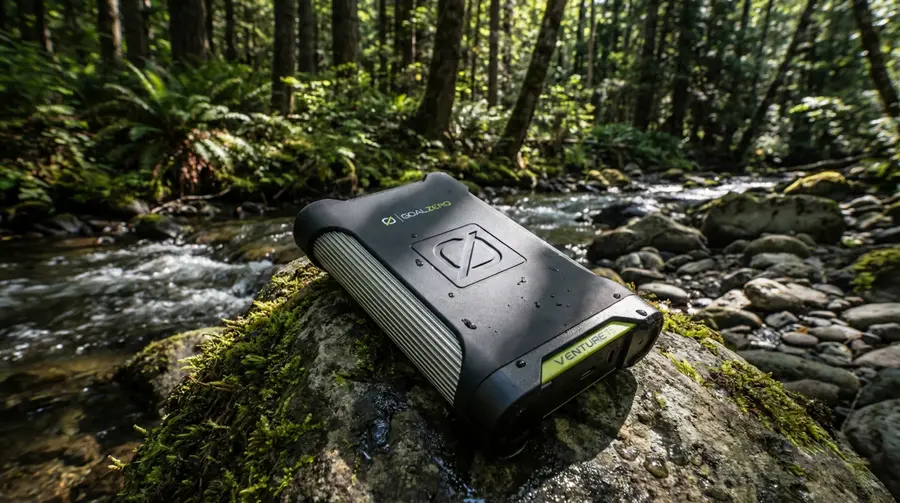
The physical design of the Venture 75 prioritizes structural rigidity and environmental resistance over aesthetic minimalism. The chassis is constructed from high-impact plastic, encased in a thermally bonded silicone rubber sleeve. This design choice serves two functional purposes: it increases the friction coefficient for handling in wet or gloved conditions and provides a mechanical buffer against vibrational stress during transit in field packs.
Port layout is centralized on the front face, featuring a gasket-sealed interface. While the device is rated for IP67, this protection is contingent upon the ports being clear of debris and the unit being dry before use. The integration of a built-in 50-lumen LED flashlight provides a secondary utility for low-light navigation, though its draw on the main battery is negligible. The footprint of the device is sized to fit within standard technical apparel pockets or accessory pouches, maintaining a balance between high-capacity power bank portability and the volume required for effective heat dissipation.
Functional Features and Systems
The Venture 75 incorporates an advanced Battery Management System (BMS) that regulates voltage and prevents overcharging, deep discharge, and thermal runaway. This is essential for maintaining the lifecycle of the NMC cells, which are rated for hundreds of cycles before significant capacity degradation occurs. Unlike basic consumer units, the power management system allows for pass-through charging, enabling the battery to receive a charge from a solar panel while simultaneously distributing power to a connected peripheral.
A critical deliberate omission is the lack of a built-in solar panel on the casing. For a high-capacity power bank designed for efficiency, integrated panels are often insufficient due to their small surface area. Instead, the Venture 75 is engineered to pair with external solar collectors, such as the Nomad 10 or Nomad 20. This modular approach ensures that the battery remains in a shaded, cooler environment while the panels are positioned for peak solar irradiance.
Performance Expectations
Under typical solar charging conditions, the performance of the Venture 75 is dictated by the input wattage of the connected array. Using a 20W solar panel in ideal clear-sky conditions (1000 W/m² irradiance), a full recharge can be expected in approximately 6 to 10 hours, accounting for conversion losses and atmospheric interference. When utilizing the 60W USB-C PD input via an AC wall adapter, the recharge time is reduced to approximately 1.5 hours.
The 60W output stability is maintained through a buck-boost converter that ensures consistent voltage even as the internal cell voltage drops during discharge. Thermal management is passive; during sustained 60W output, the casing temperature will rise, but the BMS will throttle the current if internal sensors detect temperatures exceeding 60°C to prevent hardware damage. In repeated field use, the IP67 sealing has been observed to prevent silt and moisture ingress, though the USB-C port requires periodic cleaning to ensure reliable electrical contact in saline or dusty environments.
Price and Cost-to-Performance Analysis
The Venture 75 typically occupies a price range of $100 to $120 USD. This cost is driven primarily by the inclusion of a high-wattage USB-C PD controller and the specialized IP67 ruggedized housing. When compared to standard 20,000mAh power banks found in the $40 to $60 range, the Venture 75 carries a premium for its environmental survivability and faster charging protocols.
The cost-to-performance logic centers on long-term reliability in high-stakes environments. While the upfront expense is higher, the value is realized through the avoidance of equipment failure in remote locations. For users who do not require water immersion protection or high-speed laptop charging, a standard high-capacity power bank may offer better raw capacity per dollar. However, for those operating in the solar-dependent field work category, the Venture 75 represents a durable investment that aligns with the specialized needs of outdoor power management.
Final Thoughts
The Goal Zero Venture 75 is a specialized tool for energy storage in demanding conditions. Its primary strength lies in its 60W Power Delivery and its ability to withstand environmental stressors that would likely compromise standard consumer electronics. While heavier than its peers, the durability trade-off is calculated for a specific user base that prioritizes uptime and protection over minimal weight.
For a broader perspective on how this unit compares to other market leaders, consult the comprehensive guide on the Top 10 Solar Power Banks detailed reviews and comparisons.