Anker 548 Power Bank (Reserve) Technical Evaluation
Anker 548 Power Bank (Reserve)
The Anker 548 Power Bank (Reserve) is a high-capacity portable energy storage solution designed specifically for emergency backup and off-grid scenarios. Positioned as a hybrid between a standard handheld battery and a portable power station, this device fulfills the role of a large-capacity solar power bank for users requiring multi-day energy reserves for small electronics. It exists in the solar market to bridge the gap between pocket-sized units, which often lack the surface area for meaningful solar charging, and heavy power stations that sacrifice portability. This evaluation focuses on the technical integration of its LiFePO4 chemistry and DC-input parameters when coupled with external solar arrays.
Pros & Cons
Pros
- LiFePO4 battery chemistry offers higher thermal stability and a cycle life significantly exceeding standard Lithium-ion (NMC) alternatives.
- Dedicated XT-60 solar input port supports up to 60W, allowing for standardized connection with portable solar panels without requiring proprietary adapters.
- Built-in retractable LED lamp provides high-lumen area lighting with adjustable intensity, serving as a functional emergency light source.
- Integrated SOS mode and screen-based status monitoring for precise energy management during sustained outages.
Cons
- The 60W maximum solar input limits the speed of recharge for a 192Wh capacity, necessitating optimal solar conditions for full single-day replenishment.
- Lacks an AC outlet, restricting the device to DC-powered electronics (USB-A, USB-C) and specialized DC appliances.
- Total weight of 5.1 lbs (2.3 kg) reduces its viability for ultra-light backpacking compared to lower-capacity solar power bank options.
Verified Technical Specifications
| Solar Input | 10-24V, Max 60W (XT-60 Port) |
|---|---|
| Battery Type | Lithium Iron Phosphate (LiFePO4) |
| Capacity | 192,000 mAh / 192 Wh / 60,000 mAh (at 3.2V) |
| USB-C Output (C1) | Max 60W (5V/3A, 9V/3A, 15V/3A, 20V/3A) |
| USB-C Output (C2) | Max 27W (5V/3A, 9V/3A, 12V/2.25A) |
| USB-A Output | Max 18W per port (5V/3A, 9V/2A, 12V/1.5A) |
| Recharge Methods | USB-C (PD), Solar (XT-60) |
| Dimensions | 4.5 × 4.5 × 8.1 in (115 × 115 × 207 mm) |
| Weight | 5.07 lbs / 2.3 kg |
| Operating Limits | 32°F - 104°F (0°C - 40°C) |
Design and Build Integrity
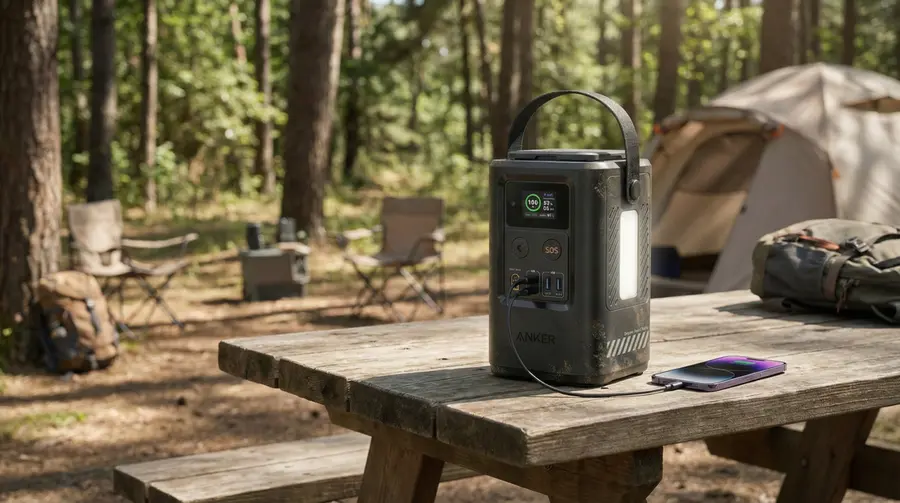
The Anker 548 utilizes a vertical "tower" form factor constructed from high-impact polycarbonate. This vertical orientation minimizes the footprint to 4.5 by 4.5 inches, making it suitable for placement on small surfaces such as nightstands or camp tables. The chassis integrates a spring-loaded, retractable LED light on the top surface, which serves dual roles: providing ambient illumination and acting as a physical handle for transit.
Port placement is centralized on the front fascia. The XT-60 solar input is positioned independently from the USB outputs, allowing for simultaneous charging and discharging without cable interference. A smart display occupies the upper section of the front panel, providing real-time data on input wattage, output wattage, estimated time to full charge, and remaining battery percentage. The physical controls consist of a main power button, a light toggle, and an SOS button, all of which provide tactile feedback. This design is optimized for high-capacity solar power bank utility in stationary or vehicle-based camping environments rather than dynamic mobile use.
Functional Features
Power Management and Safety
The device incorporates Anker’s ActiveShield 2.0 safety system. This technology monitors temperature up to 3 million times per day to prevent overheating during high-wattage USB-C Power Delivery or sustained solar input. Given the LiFePO4 chemistry, the unit is rated for 3,000 charge cycles to 80% capacity, offering a lifespan roughly four to five times longer than standard lithium-cobalt batteries.
Solar Integration
A critical feature is the inclusion of a Maximum Power Point Tracking (MPPT) controller within the XT-60 input circuit. This allows the device to maximize the energy harvested from connected solar panels by dynamically adjusting the electrical operating point of the modules. While the unit does not include an integrated panel, it is compatible with most 10-24V solar arrays, including Anker’s own 625 or 531 solar panels. This modular approach allows users to select a panel size appropriate for their environment, reinforcing its status as a robust large-capacity solar power bank.
Performance Expectations
Solar Charging Behavior
In practical applications, the 60W solar input limit means the 192Wh battery requires approximately 4 to 5 hours of peak solar irradiance for a full charge. Real-world atmospheric conditions—including haze, non-optimal panel angles, and temperature-related panel efficiency losses—typically result in an actual intake of 40-50W from a 60W or 100W panel. Users should anticipate a 6-to-8-hour window for a full recharge in typical outdoor conditions.
Output Stability and Thermal Management
The 60W USB-C output is sufficient to power most 13-inch laptops and all tablets or smartphones. During sustained 60W discharge, the internal temperature remains within operational limits due to the passive cooling design enabled by the large internal volume of the tower casing. There is no evidence of aggressive thermal throttling under standard room temperature conditions (25°C). However, using the device as a high-capacity solar power bank while simultaneously using the 60W light and 60W USB-C output may lead to increased internal temperatures, though LiFePO4 chemistry is notably more resistant to thermal runaway than its predecessors.
Pricing Analysis
The Anker 548 Power Bank (Reserve) typically occupies a price bracket between $150 and $200. This cost is driven primarily by the high-density LiFePO4 cells and the integrated MPPT solar controller. When compared to standard 20,000 mAh power banks, the cost per watt-hour is higher; however, the value proposition shifts when compared to entry-level 200Wh portable power stations.
The pricing reflects its positioning as a specialized tool for emergency preparedness. The long-term value is derived from the 3,000+ cycle life, which lowers the cost-per-cycle significantly below that of cheaper, short-lived lithium-polymer alternatives. For users seeking a large-capacity solar power bank that offers longevity and safety over raw energy-to-dollar ratios, the investment aligns with professional-grade hardware expectations.
Final Considerations
The Anker 548 (Reserve) is a specialized energy storage device that prioritizes durability and specific emergency features over general-purpose portability. Its 192Wh capacity and 60W solar input make it a reliable centerpiece for a small-scale solar kit. While it lacks the AC versatility of larger stations, its compact footprint and superior battery chemistry make it a defensible choice for residential emergency kits and medium-duration camping.