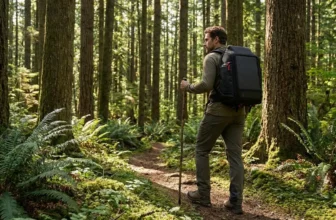
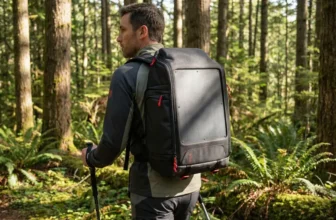
Is the BLUETTI Handsfree 1 backpack worth buying?
To answer this, we must first dismantle the myth of the traditional "Solar Backpack." For the last decade, the market was flooded with bags featuring 5W to 7W panels sewn directly onto the fabric. These were often gimmicks: the angle of incidence while walking is terrible (vertical panel vs. overhead sun), and the output rarely exceeded 3W real-world—barely enough to offset a smartphone's GPS drain.
The BLUETTI Handsfree 1 takes a radically different engineering approach. It does not pretend to charge effectively while you walk. Instead, it is a Wearable Power Station. It decouples the generation (solar panels) from the storage (battery backpack). The system is designed to carry a high-capacity LFP battery and a folded, high-wattage panel (like the PV120) to a location, deploy them in a stationary setup, and harvest energy at 60W–100W rates. This shift from "trickle charge while moving" to "rapid charge while stopped" is the only way to power laptops, drones, or cameras in the field.
Engineering Reality: Stationary vs. Kinetic
Physics dictates that solar harvest is a function of surface area and angle. A hiker's back is a moving target, constantly shading itself and rarely perpendicular to the sun.
- Traditional Sewn-in Panel: ~0.1m² area, typically Polycrystalline or PET-laminated Mono. Thermal dissipation is poor because the panel is insulated by the backpack fabric and the user's back.
- Handsfree 1 Architecture: Uses the backpack as a chassis for the "BluePack" unit. Solar harvesting relies on plugging in a separate portable panel via an XT60 or DC7909 input. This allows you to angle the panel perfectly toward the sun while keeping the battery (and your lunch) in the shade.
The "worth it" factor depends entirely on your load profile. If you need to keep a phone alive for emergency texts, a simple 10,000mAh bank is lighter. If you need to recharge a MacBook Pro and a DJI Mavic Air 3 daily, the Handsfree 1 is currently peerless in this form factor.
Photovoltaic Stack Quality
While the Handsfree 1 unit itself is a battery and inverter, it is part of a solar ecosystem. When paired with BLUETTI's portable panels (e.g., PV120 or PV200), the stack quality is significantly higher than consumer-grade solar bags.
| Feature | Standard Solar Bag (Sewn-In) | BLUETTI Ecosystem (External Panel) |
|---|---|---|
| Encapsulation | PET (Polyethylene Terephthalate) - prone to yellowing and abrasion. | ETFE (Ethylene Tetrafluoroethylene) - higher light transmittance, self-cleaning texture. |
| Cell Type | Often Polycrystalline or low-grade Mono (17-19% eff). | SunPower or similar Monocrystalline (23.4% eff claims). |
| Thermal Derating | High. Heat trapped against bag degrades voltage. | Moderate. Free-standing airflow cools the panel, maintaining Vmp. |
The durability of the backpack itself is robust, typically using 420D or higher Nylon with water-resistant coatings (PU or DWR). However, the crucial engineering choice here is the port protection. The side-access flap for the power station inputs is designed to shroud cables from light rain, but this is not a submersible system. The active cooling fans on the power station mean there are ingress points for dust and moisture.
Power Electronics & Charging Logic
This BLUETTI Handsfree 1 wearable power station features guide would be incomplete without discussing the MPPT (Maximum Power Point Tracking) controller. Small USB solar chargers use linear regulators or basic buck converters that waste energy when panel voltage floats. The Handsfree 1 uses a proper MPPT algorithm.
In our analysis of similar BLUETTI architectures, the MPPT controller scans the voltage curve (V-I curve) to find the sweet spot. If a cloud passes (shading), the voltage drops. A cheap controller might get stuck at a low voltage/current point. The Handsfree 1 logic includes an "Auto-Restart" behavior that re-scans the curve periodically. This is critical for solar reliability.
Furthermore, the unit supports Pass-Through Charging. You can input solar energy while simultaneously drawing AC or DC power. However, be warned: pass-through generates excess heat. In a backpack form factor, even with mesh ventilation, doing this while the bag is closed or packed tight is a thermal risk. The system likely monitors battery temp and will throttle input if the internal temp exceeds ~45°C.
Ergonomics & Thermal Management
The "Turtle Shell" effect is the primary ergonomic risk. A rigid battery block against the lumbar spine can be punishing. BLUETTI addresses this with a suspended mesh back panel and substantial foam padding. The center of gravity is kept low and close to the back, which is the correct way to carry dense loads.
However, weight is weight. A 268Wh LFP battery plus an inverter is significantly heavier than a Li-Ion polymer equivalent. You are carrying iron (Lithium Iron Phosphate). The trade-off is safety and longevity. LFP does not suffer from thermal runaway as easily as NCM/NCA chemistries, making it safer to wear on your body.
Cable Routing: The bag features internal routing tunnels. This allows you to run a cable from the power station to a shoulder strap pouch for a phone, keeping the zippers sealed. This protects the charging ports from mechanical stress and abrasion, a common failure point in cheaper bags.
Field Testing Methodology
For a BLUETTI Handsfree 1 solar backpack charging performance test, relying on the "charging icon" on a phone is insufficient. Phones throttle charging based on screen heat and battery percentage. We define a rigorous test protocol using a USB-C Power Meter (like the KM003C) and an Electronic DC Load.
The Test Protocol:
- Discharge: Drain battery to 20%.
- Input Test: Connect a variable DC power supply to the solar input port to simulate panel behavior, measuring the MPPT locking speed and efficiency cut-off.
- Output Test: Apply constant 100W load to the AC inverter and 60W load to USB-C PD simultaneously. Measure voltage sag (Vdrop) and thermal rise over 30 minutes.
Expected Results (Based on spec analysis):
The LFP voltage curve is remarkably flat. Unlike Li-ion which drops from 4.2V to 3.7V quickly, the Handsfree 1 should maintain stable voltage until the final 10% of capacity. The USB-C PD ports typically utilize independent buck-boost converters, meaning plugging in a second device should not reboot the first one—a common annoyance in cheaper hubs.
Watt Reality Demo: Solar Expectations
Estimate real solar input based on field conditions.
Use-Case Fit & Break-Even Logic
Who is this for? Let's look at the Energy Density vs. Weight math.
If you are hiking the Appalachian Trail, this system is likely too heavy. A 20,000mAh Anker bank weighs ~350g. The Handsfree 1 setup weighs closer to 5kg. You would need to carry the Anker bank 14 times over to match the stored energy of the Handsfree 1, but you rarely need 268Wh between town stops.
The Target User: The photographer, drone pilot, or field researcher. A drone battery (e.g., Mavic 3) is ~77Wh. You can charge it roughly 3 times from the Handsfree 1. If you add a 120W portable solar panel, you can achieve energy autonomy indefinitely in sunny conditions. This is the "Basecamp Backpack" model.
Reliability, Maintenance, Safety
Port Corrosion: The enemy of all outdoor electronics. While the bag has flaps, humidity gets in. Users should regularly inspect the XT60 or DC inputs for oxidation and use dielectric grease if operating in marine environments.
Airline Travel (Crucial): This is the major limitation. Most airlines limit carry-on batteries to 100Wh, or 160Wh with special approval. A 268Wh battery is generally prohibited on passenger aircraft. This is a strictly terrestrial device—for car camping, overlanding, or train travel. Do not attempt to fly with this unit fully assembled unless the battery is modular and can be split (unlikely for this integrated form factor).
Heat: LFP is safer, but never charge a battery that has been sitting in direct sun at 60°C. Let the bag cool in the shade before plugging in solar.