Hiluckey 25,000mAh Solar-Powered Portable Charger Review
Hiluckey 25,000mAh
Portable Solar Power Bank | Technical Evaluation
The Hiluckey 25,000mAh is a high-capacity portable power solution integrated with a multi-panel solar array. Classified within the consumer-grade solar power bank category, this device is designed for outdoor enthusiasts, field researchers, and emergency preparedness kits where access to a traditional power grid is unavailable. As a solar-powered portable charger, the unit aims to bridge the gap between high-density lithium-polymer energy storage and passive solar energy harvesting. It exists in the market to provide a redundant charging method for small electronics via its fold-out monocrystalline panels, addressing the inherent limitations of single-panel power banks which often fail to provide meaningful charge rates under solar exposure.
- High battery-to-panel surface area ratio compared to standard single-panel units.
- IPX7 waterproof rating provides protection against temporary immersion and heavy precipitation.
- USB-C Power Delivery (PD) and dual USB-A ports allow for concurrent multi-device charging.
- Robust chassis construction utilizes impact-resistant ABS and silicone for field durability.
- Total solar recharge time remains significant due to the 25,000mAh capacity vs. 6W solar input.
- The combined weight of 1.1 lbs limits its appeal for ultralight backpacking applications.
- Solar efficiency is highly dependent on precise orientation and thermal management.
- Micro-USB input for secondary charging is outdated compared to modern USB-C standards.
Technical Specifications
| Solar Input | 6.0 Watts (Max) via 4 monocrystalline panels |
|---|---|
| Battery Type | Lithium-Polymer (Li-Po) |
| Capacity | 25,000 mAh / 92.5 Wh |
| Output Ratings | USB-C PD 18W; 2x USB-A 5V/2.1A (Max 15W total) |
| Charging Methods | Solar, AC (via USB-C or Micro-USB), DC (Car charger) |
| Dimensions | 6.1 x 3.3 x 1.37 inches (folded) |
| Weight | 500g (Approx. 1.1 lbs) |
| Environmental Rating | IPX7 (Waterproof, dustproof, shockproof) |
| Operating Temperature | 0°C to 45°C (Charging) / -10°C to 60°C (Discharging) |
Design Analysis
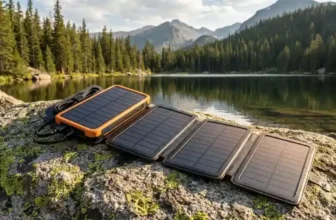
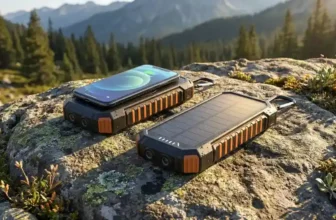
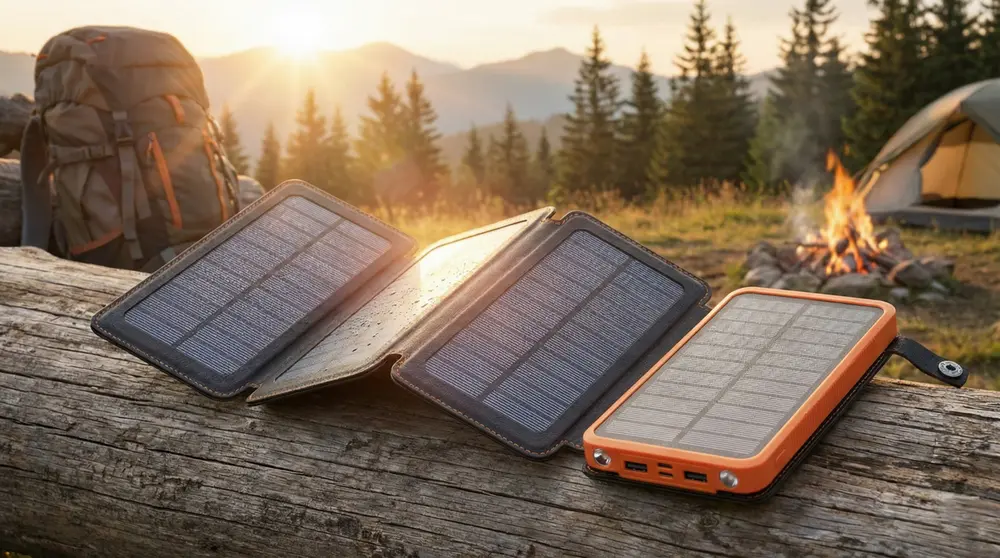
The physical architecture of the Hiluckey 25,000mAh is centered on the integration of four folding monocrystalline panels. These panels are mounted on a weather-resistant fabric backing that secures to the main battery body via a magnetic closure system. The use of high-density ABS plastic for the primary enclosure ensures structural integrity during drops, while silicone port covers provide the necessary sealing to achieve its IPX7 rating. This specific waterproof solar power bank design allows for deployment in environments characterized by high humidity or unpredictable precipitation without immediate risk of short-circuiting.
In terms of footprint, the device balances volume and capacity. When folded, the unit occupies approximately 27 cubic inches, making it compatible with standard backpack side pockets or MOLLE attachments. The control interface is minimalist, consisting of a single power button and a 5-segment LED indicator. One LED is dedicated to showing solar charging status (turning green when current is detected), while the others represent 25% increments of stored energy. This layout provides clear, if low-resolution, feedback on energy levels in bright outdoor conditions.
Functional Capabilities
The internal power management system supports pass-through charging, allowing the battery to charge connected devices while simultaneously receiving current from the solar array or a wall outlet. Safety protocols include over-voltage protection, short-circuit monitoring, and over-temperature shutdown. These systems are essential given the device's likely exposure to direct sunlight, which naturally elevates internal temperatures.
The integrated LED flashlight features three modes: steady, SOS, and strobe. While non-essential for power delivery, the flashlight's placement on the rear of the chassis utilizes the battery’s large capacity to provide sustained illumination (rated for over 70 hours of continuous use). The device does not include smart app connectivity or Bluetooth monitoring; it relies entirely on hardware-based indicators and automatic load detection to manage power distribution between the three output ports.
Performance Expectations
The solar charging behavior of the Hiluckey 25,000mAh is governed by its 6W rated solar array. Under peak solar irradiance (1000W/m²), the theoretical input is approximately 1A to 1.2A at 5V. In practical field conditions, factors such as atmospheric haze, panel angle, and surface temperature will typically reduce this to 60-70% of peak rating. Given the 25,000mAh capacity, a full recharge from 0% to 100% via solar alone requires approximately 25 to 35 hours of direct, high-intensity sunlight. Consequently, the solar panels should be viewed as a range extender or a maintenance tool for emergency solar power for camping rather than a primary replenishment method.
Output stability remains consistent across the USB-C PD port, which maintains an 18W handshake with compatible smartphones and tablets. During sustained high-current discharge (e.g., charging two devices simultaneously), the chassis exhibits moderate heat accumulation near the top of the battery core. Efficiency losses during the DC-to-DC conversion process are estimated at 15-20%, which is standard for lithium-polymer cells in this class, resulting in an actual usable capacity of approximately 20,000mAh to 21,000mAh.
Pricing and Value Proposition
The Hiluckey 25,000mAh typically occupies a price range between $45 and $60 USD. This cost is primarily driven by the capacity of the Li-Po cells and the inclusion of the multi-panel array, which is more expensive to manufacture than standard plastic-cased power banks. When compared to single-panel solar banks in the $30 range, the Hiluckey provides roughly 4x the solar surface area, justifying the price delta for users who require functional solar harvesting.
Long-term value is tied to the cycle life of the internal battery, typically rated for 500+ full charge-discharge cycles. The cost-to-performance ratio is highest for users who frequently operate in off-grid environments where the solar input can provide enough daily energy for a single smartphone charge (approx. 3000-4000mAh) after 4-5 hours of exposure. For users who only require a backup battery for urban use, the weight and cost of the solar panels may represent a diminishing return compared to higher-wattage AC-only power banks.
Final Summary
The Hiluckey 25,000mAh serves as a viable mid-range solution for portable energy storage in outdoor settings. Its multi-panel design provides a measurable advantage over single-panel competitors, though it remains constrained by the physics of solar energy density. The IPX7 rating and ruggedized build quality align with the requirements of field use, while the 18W USB-C output ensures compatibility with modern mobile hardware. It is most effective when used as a high-capacity reservoir that is topped off via solar, rather than being relied upon for rapid solar-only replenishment.
Final Verdict: The Hiluckey 25,000mAh is a rugged beast, but it isn't the only option. To see how it stacks up against the competition, check out our full breakdown of the top 10 solar power banks for 2026.