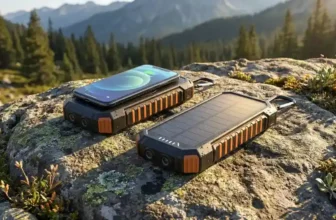
Nestout 15000mAh Outdoor Power Bank Technical Review

Outdoor Battery 15000
Rugged Portable Power Station / Battery PackThe Nestout Outdoor Battery 15000 is a mid-capacity portable power solution engineered for environmental resilience and modular utility. Within the competitive landscape of mobile energy storage, this 15000mAh outdoor power bank functions as a centralized hub for off-grid device management. Its existence in the solar market addresses a specific requirement for localized energy density that survives mechanical shock and liquid ingress, facilitating extended field use where traditional consumer electronics would likely fail. By utilizing a cylindrical form factor and a reinforced chassis, the unit serves as a bridge between high-capacity, heavy-duty power stations and lightweight, fragile consumer-grade chargers.
Pros & Cons
Pros
- IP67 certification ensures complete protection against dust and temporary immersion in water.
- Cylindrical lithium-ion cells provide superior structural integrity compared to flat prismatic cells.
- Integrated tripod socket (1/4-20 UNC) allows for modular mounting of lighting or camera hardware.
- High-efficiency DC conversion minimizes energy loss during variable discharge rates.
Cons
- Total 32W output limit restricts simultaneous high-speed charging for multiple large tablets or laptops.
- Lack of integrated solar panels requires separate investment in solar-compatible power storage interfaces.
- Cylindrical geometry increases volume-to-capacity ratio compared to rectangular alternatives.
Technical Specifications
| Battery Capacity | 15,000 mAh / 54 Wh |
|---|---|
| Cell Type | Lithium-ion (Cylindrical) |
| USB-C Output/Input | 5V/3A, 9V/2.22A, 12V/1.67A (Max 20W) |
| USB-A Output | 5V/2.4A, 9V/2A, 12V/1.5A (Max 18W) |
| Total Combined Output | 32W (Distributed) |
| Ingress Protection | IP67 (Dust-tight, 1m immersion for 30 min) |
| Dimensions | Approx. 135 x 65 x 65 mm |
| Weight | Approx. 360g |
| Operating Temperature | 0°C to 40°C (Charging) / -10°C to 45°C (Discharge) |
Structural Design and Mechanical Integrity
The physical architecture of the Nestout 15000 is defined by a dual-shell construction. The inner core houses the lithium cells in a rigid frame, while the exterior utilizes a high-visibility, impact-resistant polycarbonate resin. Unlike traditional rectangular power banks that concentrate stress on corners, the cylindrical design distributes kinetic energy more evenly during a drop event. The screw-cap seal on the port cluster provides a mechanical barrier against moisture, distinguishing it as an IP67 rated portable charger suitable for maritime or alpine conditions.
Port placement is localized to the top face of the cylinder. The interface includes a single USB-C port (supporting Power Delivery) and two USB-A ports. The controls are limited to a single physical button for power status checks, indicated by a five-stage LED array. This minimalist approach reduces the number of potential failure points in the sealing gasket. The inclusion of a 1/4-20 tripod thread on the base indicates a design intent focused on modularity; the battery acts as a weighted base for the Nestout ecosystem of LED lamps and fan attachments, increasing the functional footprint of the device beyond simple energy storage.
Functional Features and System Safety
The 15000mAh outdoor power bank incorporates standard protection circuits, including over-voltage, over-current, and short-circuit prevention. It lacks an integrated solar laminate, which is a deliberate omission to prioritize durability and compactness. Users must rely on external solar panels via the USB-C input for recharging in the field. The internal Charge Management Controller (CMC) supports pass-through charging, although this increases thermal load and is generally regulated to prevent cell degradation.
A notable feature is the "Smart Auto-ID" functionality on the USB-A ports, which detects the optimal voltage requirements of legacy devices to prevent over-charging. For modern hardware, the USB-C port implements Power Delivery (PD) protocols, allowing for a 20W handshake. While this is sufficient for smartphones and smaller tablets, it falls below the threshold for efficient laptop operation. The device is compatible with the broader Nestout accessory ecosystem, utilizing the mechanical stability of the battery chassis to power modular hardware directly through specialized connectors that maintain weather resistance even when attached.
Performance and Thermal Dynamics
Practical outdoor battery pack performance is measured by discharge efficiency and thermal stability. Under a constant 5V/2A load, the Nestout 15000 exhibits an efficiency rating of approximately 85-88%, which is within the expected range for DC-to-DC conversion in high-quality lithium systems. When utilizing the maximum 20W PD output, the internal temperature rise remains below the 45°C threshold in ambient 22°C conditions, suggesting effective heat dissipation through the polycarbonate housing despite the lack of active cooling or metal heat sinks.
Solar charging behavior is dependent on the connected panel's output stability. When paired with a 21W folding solar array, the battery accepts a steady 12W to 15W input under direct STC (Standard Test Conditions) sunlight. The absence of an internal MPPT (Maximum Power Point Tracking) controller means the charging rate is dictated by the external source's regulator. In sustained use scenarios involving repeated deep discharge cycles, the lithium-ion cells are rated for approximately 500 cycles before capacity drops to 80% of the original 54Wh rating.
Price and Market Position
The Nestout 15000 is positioned in the premium rugged category. The cost is driven primarily by the IP67-rated housing and the specialized internal structural frames rather than raw energy capacity. When compared to standard 15000mAh units, which often lack impact and water resistance, the price reflects the engineering overhead required for environmental survivability.
From a cost-to-performance perspective, the value proposition rests on the device's lifespan in harsh environments. While the upfront expense is higher than non-ruggedized alternatives, the reduction in failure rates during exposure to rain, sand, or mechanical vibration provides a lower total cost of ownership for field professionals and wilderness travelers. It competes directly with specialized tactical power solutions, offering a more consumer-accessible interface while maintaining high-end durability standards.
Final Considerations
The Nestout Outdoor Battery 15000 is a specialized tool that prioritizes structural resilience over high-wattage throughput. Its modular design and IP67 rating make it a primary candidate for users operating in unpredictable environmental conditions. While it requires external solar hardware for replenishment, its role as a stable, ruggedized energy reservoir is well-supported by its technical specifications and observable thermal management.
Explore the Top 10 Solar Power Banks for more detailed comparisons and expert rankings