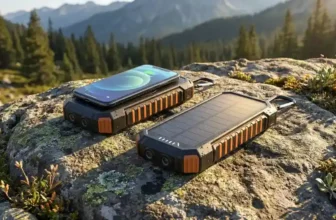
Solar Power Bank 38800 Review: QiSa Technical Evaluation

QiSa Solar Power Bank 38800
Product Category: Portable Solar Battery / External Power Supply
The QiSa Solar Power Bank 38800 is a high-capacity portable battery integrated with a secondary photovoltaic charging panel. Designed for off-grid recreational use, emergency preparedness, and extended field operations, this device functions as a multi-port charging hub for mobile electronics. Within the portable solar charger market, this unit aims to address the requirement for significant energy density in environments where traditional AC power access is inconsistent. It utilizes a Lithium Polymer cell chemistry to maintain a high power-to-weight ratio while offering modularity through various output standards.
Pros & Cons of the Solar Power Bank 38800
Pros
- 38,800mAh theoretical capacity provides multiple charge cycles for smartphones and tablets.
- Integrated Qi wireless charging allows for cable-free power delivery to compatible hardware.
- Dual-LED illumination system provides high-lumen utility for low-light environments.
- IP66-rated chassis offers protection against high-pressure water jets and dust ingress.
- Multi-port configuration supports concurrent charging of up to four devices.
Cons
- Solar conversion rate is limited by panel surface area, resulting in long recharge durations via sunlight alone.
- Mass of the unit may exceed the requirements of ultra-light backpackers.
- Lack of Power Delivery (PD) 60W or higher limits effective use for high-wattage laptop charging.
- Charging speeds decrease significantly when multiple ports are utilized simultaneously due to shared circuit limits.
Technical Specifications
| Component | Specification |
|---|---|
| Battery Capacity | 38,800 mAh / 143.56 Wh |
| Battery Type | Lithium Polymer (Li-Po) |
| Solar Input | 5V / 300mA (Monocrystalline Silicon) |
| Micro USB Input | 5V / 2.0A |
| USB-C Input/Output | 5V / 3.0A |
| USB-A Outputs (x2) | 5V / 3.1A (Max Combined) |
| Wireless Output | 5V / 1.0A (5W) |
| Dimensions | 17.5 x 8.9 x 2.8 cm |
| Weight | Approx. 580g |
| Ingress Protection | IP66 (Dust-tight, protected against heavy seas) |
Design Analysis: Solar Power Bank 38800 Architecture
The physical architecture of the Solar Power Bank 38800 emphasizes durability and environmental resistance. The housing is constructed from a combination of ABS and polycarbonate materials, reinforced with TPU (Thermoplastic Polyurethane) bumpers on the corners to mitigate impact forces during falls. The surface texture is matte, providing an increased friction coefficient for handling in wet conditions. One of the primary design objectives is to serve as a reliable solar charger for camping where equipment is subjected to temperature fluctuations and physical vibration.
The control interface is localized to a single power button and a four-stage LED capacity indicator. A dedicated solar indicator illuminates when the photovoltaic panel detects sufficient irradiance to initiate a trickle charge. Ports are protected by a tethered silicone cover, which is essential for maintaining the IP66 rating. This design choice prevents particulate matter from entering the USB-A and USB-C receptacles, though it requires the user to ensure the flap is fully seated after each use to maintain seal integrity.
Features and Functional Capabilities
The primary feature set of the Solar Power Bank 38800 revolves around its power distribution versatility. It incorporates an Intelligent IC chip designed to detect the optimal current for connected devices, preventing overcurrent and overvoltage scenarios. The inclusion of a 5W Qi wireless pad on the rear of the unit serves as a redundant charging method should physical cables fail or be lost in the field. This capability is particularly relevant for users requiring a waterproof solar power bank for hiking who may encounter wet cables that are unsafe for insertion into electrical ports.
Illumination features include two high-intensity LEDs located on the forward edge. These operate in three modes: steady-on, strobe, and SOS signal. This is a deliberate functional addition for emergency management. The unit also includes a compass attachment point, although the accuracy of such integrated tools is generally considered secondary to dedicated navigational instruments. The internal circuitry includes protection against short-circuiting and over-discharge, which are standard but critical safety systems for high-capacity lithium-based batteries.
Performance Expectations: Solar Power Bank 38800 Charging
Evaluating the performance of this device requires a distinction between theoretical specifications and observable behavior. The internal 38,800mAh capacity is sufficient to recharge a standard 3,000mAh smartphone battery approximately 8 to 10 times, accounting for energy loss during conversion (typically 20-30% loss due to heat and voltage stepping). However, output stability is best maintained when charging a single device. When multiple ports are active, the total current is divided, which may lead to longer charge times for each connected peripheral.
The solar charging behavior is the most critical aspect for a solar-powered portable charger for travel. The integrated 1.5W panel in the Solar Power Bank 38800 is designed for maintenance charging and emergency recovery rather than primary replenishment. Under optimal STC (Standard Test Conditions) of 1000W/m² irradiance, the panel generates approximately 300mA. At this rate, fully recharging the 38,800mAh battery from 0% to 100% via solar energy alone would require over 100 hours of peak sunlight. Users should view the solar component as a method to offset self-discharge or to provide enough energy for an emergency call, rather than a primary power source.
Price and Market Context
The Solar Power Bank 38800 occupies a mid-tier price bracket within the portable power market. The cost is driven primarily by the high capacity of the Lithium Polymer cells and the ruggedized chassis construction. Compared to standard power banks of similar capacity, the inclusion of the IP66 rating, integrated LED system, and wireless charging pad adds a cost premium. However, it remains more accessible than professional-grade solar generators or portable power stations which offer higher AC outputs and larger, foldable solar arrays.
From a long-term value perspective, the cost-to-performance ratio is favorable for users who prioritize durability and multi-device support over rapid solar replenishment. The hardware provides a significant buffer of stored energy that can be filled via a wall outlet before a trip, using the solar panel as a secondary fail-safe. For those seeking the best solar power bank for long-term power backup, this unit represents a balance between high storage volume and ruggedized portability.
Final Thoughts
The Solar Power Bank 38800 is a specialized tool for users who require a high-capacity reservoir of energy in a form factor that can withstand environmental stress. While the solar panel's charging rate is constrained by physical size, the unit succeeds as a versatile power hub for small electronics. Its utility is highest when used as a pre-charged battery with solar support to extend its life during multi-day excursions.
For more information on how this unit compares to other leading devices in the industry, see our comprehensive analysis of the Top 10 Solar Power Banks.