Riapow 26800mAh Wireless: Solar Power Bank for Camping Review

Riapow 26800mAh Wireless
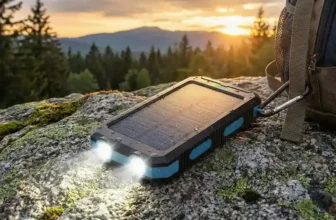
Portable Energy Storage / Solar Power BankThe Riapow 26800mAh Wireless model is a high-capacity portable energy storage device designed for extended off-grid use, specifically functioning as a solar power bank for camping and emergency preparedness. Utilizing a lithium-polymer battery chemistry, the unit integrates a monocrystalline solar panel intended for secondary charging, alongside a multi-output interface including Qi-standard wireless induction. This product occupies a segment of the market that balances high nominal energy density with environmental resilience, providing a buffer against power depletion in scenarios where traditional AC infrastructure is inaccessible.
Pros & Cons
Pros
- High nominal capacity of 26800mAh (99.16Wh) permits multiple full recharges for standard mobile devices.
- Integrated Qi-certified 5W wireless charging reduces reliance on physical cable integrity.
- IPX6-rated construction provides protection against high-pressure water streams and environmental ingress.
- Simultaneous four-device charging capability supports complex hardware ecosystems.
Cons
- Solar conversion rate is limited by panel surface area, requiring significant duration for meaningful replenishment.
- Total weight exceeds 450 grams, which may impact ultralight backpacking loadouts.
- Lack of Power Delivery (PD) 3.0 or higher limits fast-charging speeds for modern laptops.
Technical Specifications
| Battery Capacity | 26,800mAh / 99.16Wh |
|---|---|
| Battery Type | Lithium Polymer (Li-Po) |
| Solar Input | 1.5W Monocrystalline (5.5V / 270mA) |
| Micro USB Input | 5V / 2.0A |
| USB-C Input | 5V / 3.0A |
| USB Output (x2) | 5V / 3.1A (Total Max) |
| Wireless Output | 5W (Qi Standard) |
| Dimensions | 176 x 93 x 29 mm |
| Weight | Approx. 490g |
| Ingress Protection | IPX6 |
Structural and Functional Design
The chassis of the Riapow 26800mAh Wireless is constructed from high-impact ABS and Polycarbonate (PC) materials, reinforced with silicone bumpers on the corners to mitigate kinetic damage from drops. The design prioritizes durability over aesthetics, featuring a textured exterior to enhance grip in humid or wet conditions. The monocrystalline solar panel is flush-mounted to the top surface, protected by a transparent, scratch-resistant coating.
Port integration is centered on the top edge, protected by a heavy-duty silicone gasket. This gasket is critical for maintaining the IPX6 rating, though it requires precise seating to prevent moisture ingress. The layout includes dual USB-A ports, a bidirectional USB-C port, and a legacy Micro-USB input. On the rear surface, the wireless charging coil is marked by a non-slip ring, facilitating alignment between the power bank and the device.
For visual monitoring, the device utilizes a five-stage LED indicator system. Four blue LEDs denote increments of 25% battery capacity, while a single green LED illuminates when the solar panel is actively generating a voltage differential. This provides immediate feedback on solar intensity without requiring a digital interface. The inclusion of a 60-LED array on the underside serves as a high-lumen floodlight, offering three modes: Steady, Flash, and SOS, which are controlled via a dedicated physical button on the side panel.
Functional Capabilities
The core feature set of the Riapow 26800mAh Wireless is defined by its multi-device outdoor power solution architecture. The intelligent Power Management IC (PMIC) is designed to detect the optimal charging current for connected devices, preventing overcurrent and overvoltage scenarios. Unlike simpler models, this unit supports pass-through charging, allowing the battery to replenish via DC input while simultaneously discharging power to connected peripherals.
The wireless charging functionality is a distinct advantage for users operating in environments where cable failure is a risk. By utilizing the Qi inductive standard, the wireless charging solar battery pack eliminates the physical wear associated with port usage. However, users should note that the 5W output is significantly slower than wired alternatives and is subject to efficiency losses due to coil misalignment or thick protective cases.
The built-in safety systems include thermal monitoring, which throttles output if internal temperatures exceed defined thresholds (typically 60°C). Short-circuit protection is also implemented at the hardware level, ensuring that faults in connected cables do not damage the internal lithium-polymer cells. The omission of complex smart app integration reduces points of failure, prioritizing reliability in remote locations.
Performance Expectations
Real-world performance of the high capacity 26800mAh portable charger is subject to thermal and chemical efficiency losses. While the nominal capacity is 99.16Wh, the actual usable energy delivered at the output is typically 70-80% due to voltage conversion (3.7V internal to 5V output) and heat dissipation. Under standard conditions, the unit is capable of recharging a 3,000mAh smartphone approximately six to seven times.
Solar performance is the most variable metric. With a 1.5W panel, the maximum theoretical current is 270mA under peak solar irradiance (1000W/m²). In practical outdoor scenarios, environmental factors such as atmospheric haze, panel angle, and temperature-induced efficiency drops mean that solar charging is effectively a maintenance or emergency feature. To fully replenish the 26,800mAh capacity solely via solar energy would require approximately 150 to 200 hours of direct, unobstructed sunlight.
Heat management is robust due to the ABS/PC shell, but users are advised against leaving the unit in enclosed, high-temperature environments (such as a vehicle dashboard) while charging. Sustained high-current discharge through multiple ports will induce thermal build-up, which may trigger safety throttling, reducing output to 1.0A per port to protect the battery chemistry.
Price and Market Position
The Riapow 26800mAh Wireless typically retails in the $35 to $55 price range. The cost is driven primarily by the high-density lithium-polymer cells and the integration of the Qi wireless charging coil and monocrystalline panel. Compared to standard power banks of similar capacity, the premium reflects the IPX6-rated housing and the specialized outdoor features like the 60-LED floodlight.
Long-term value is realized in the device's cycle life, typically rated for 500+ full charge/discharge cycles before capacity drops below 80% of its original rating. For users requiring a ruggedized, multi-input solution for off-grid travel, the upfront expense is balanced by the reduction in modular requirements (eliminating the need for separate flashlights or wireless pads).
Final Thoughts
The Riapow 26800mAh Wireless is a specialized tool for users who prioritize capacity and environmental durability over fast-charging speeds or lightweight design. It functions reliably as a central hub for low-wattage electronics in field conditions. While the solar panel should not be viewed as a primary charging method, its presence provides a critical safety margin for low-power emergency signaling.
For a broader comparison of similar devices, consult our comprehensive analysis of the:
Top 10 Solar Power Banks: Detailed Reviews and Comparisons