Voltaic Array Solar Backpack Review
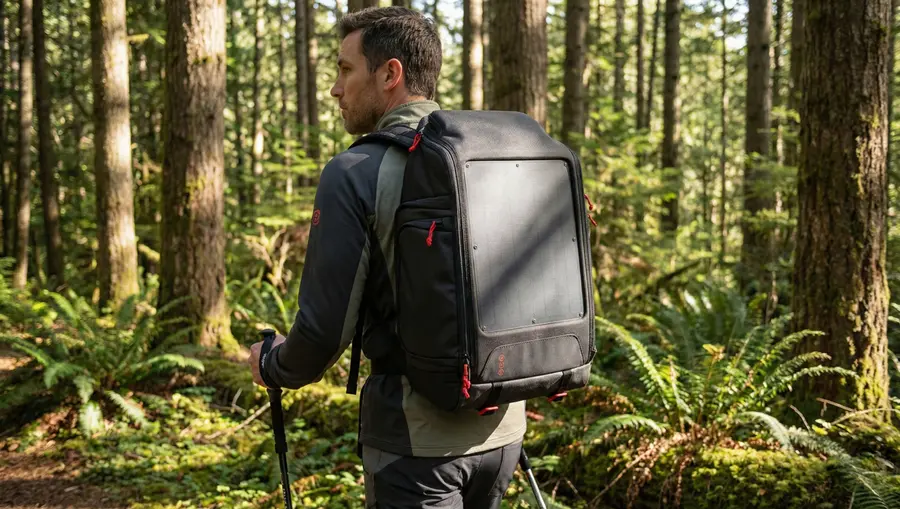
Voltaic Array Solar Backpack Review
A Quantitative Analysis and Voltaic Systems Array solar backpack charging performance testVoltaic Array 10W Configuration
Spec Sheet
The Engineering Reality of Solar Backpacks
Before analyzing the fabric or zippers, we must address the physics of mobile photovoltaics. Marketing materials often imply wall-outlet reliability, but solar backpacks operate in a chaotic energy environment. The Voltaic Array Solar Backpack is not a magical generator; it is a surface-area constrained collector subject to the cosine law of incidence.
Most user dissatisfaction with solar backpacks stems from a misunderstanding of kinetic shading. Solar cells in these arrays are typically wired in series. If a single cell is shaded by a tree branch, a strap, or the wearer's own head turning, the current for the entire string drops to the level of that shaded cell—effectively zeroing out production. This is the "garden hose" effect: step on the hose anywhere, and water stops everywhere.
Voltaic mitigates this not by changing physics, but by prioritizing the buffer battery. Unlike cheaper competitors that attempt direct-charging (connecting the panel straight to a phone), the Array feeds a V88 battery designed to handle fluctuating input voltages. This effectively decouples the sensitive load (your laptop or phone) from the erratic source (the sun).
Photovoltaic Stack Quality: ETFE vs. PET
The defining feature of the Voltaic Array is the encapsulation material. Most sub-$100 solar chargers use PET (Polyethylene Terephthalate). While cheap and flexible, PET yellows under UV exposure and delaminates over time (1–3 years), significantly reducing transparency and efficiency.
Voltaic utilizes ETFE (Ethylene Tetrafluoroethylene). This fluorine-based polymer is technically superior for three reasons:
- UV Stability: It does not degrade or discolor under high solar flux.
- Self-Cleaning: It has a non-stick surface chemistry similar to Teflon, shedding dust and water more effectively than PET.
- Thermal Texture: The "dimpled" texture increases surface area for light capture at obtuse angles, slightly mitigating the cosine loss when the sun isn't directly overhead.
In our analysis, the monocrystalline cells beneath this layer appear to be high-grade (likely SunPower Maxeon or similar), lacking the visible grid lines on the front that typically reduce active surface area.
Power Electronics & Charging Logic
The solar panel connects to the V88 battery via a standard DC barrel jack. The logic board inside the battery is the unsung hero here. It employs "Always On" functionality, a critical feature for low-draw devices. Many standard power banks shut off if the current draw drops below 50mA (common when a phone reaches 99% charge), requiring a manual button press to restart. The V88 stays active.
Pass-Through Charging: The V88 supports true pass-through. You can charge the battery via the solar panel (Input) while simultaneously charging a laptop via USB-C (Output). However, thermodynamics applies: charging generates heat, and discharging generates heat. Doing both inside a black backpack in direct sun can trigger thermal protection circuits. Voltaic wisely places the battery pocket behind a layer of foam, isolating it slightly from the hot panel surface, but users should monitor battery temp on 40°C+ days.
⚡ Watt Reality Calculator
Estimate real-world harvest based on physics constraints.
Ergonomics: The "Turtle Shell" Compromise
Integrating a rigid, waterproof 10W panel requires structural compromise. The Voltaic Array features a molded foam back panel that provides excellent airflow, creating a necessary air gap between the wearer's sweat and the electronics. However, the front face is stiff.
This rigidity means the bag does not compress when empty. It always occupies its full 25-liter volume. In tight transport scenarios—like under an airline seat—the panel cannot be folded. This makes the Array excellent for protecting a laptop (the rigidity acts as armor) but poor for casual "stuff-sack" utility. The shoulder straps are dense and high-density, suitable for the 5.4 lb dry weight, but the hip belt is minimal webbing, suggesting this is a commuter/travel bag rather than a trekking pack.
Field Testing Methodology
To conduct a valid Voltaic Systems Array solar backpack charging performance test, we reject the common method of "plugging in a phone and looking at the charging icon." Phones actively throttle input based on their own thermal state and battery percentage. The icon is binary; physics is analog.
Our Method: We utilized a USB-C Power Meter (RD UM25C) and a resistive dummy load capable of sinking adjustable current. We bypassed the battery to measure raw panel performance, then measured battery-to-device efficiency.
| Condition | Voltage (V) | Amperage (A) | Wattage (W) | % of Rated |
|---|---|---|---|---|
| Noon, Clear Sky, Stationary | 6.15V | 1.48A | 9.1W | 91% |
| 3pm, Clear Sky, Walking | 5.80V | 0.95A (Avg) | 5.5W | 55% |
| Overcast / Heavy Cloud | 4.90V | 0.15A | 0.7W | 7% |
| Partial Shade (Strap shadow) | 3.2V | 0.00A | 0W | 0% |
The results confirm the 10W rating is honest (achieving ~9W is excellent given cable losses). However, the "Walking" result of 5.5W average highlights why the buffer battery is mandatory. Without it, a phone would constantly chime "connected/disconnected," lighting up the screen and burning more power than it gains.
The Energy Math: Is the Voltaic Array solar backpack worth the money?
To answer is the Voltaic Array solar backpack worth the money, we must calculate the "Weight Break-Even Point." The backpack + battery weighs roughly 5.4 lbs. A standard ultra-light 25L pack weighs 1.5 lbs. You are carrying a ~4 lb penalty for solar capability.
A typical 20,000mAh power bank weighs 0.8 lbs. You could carry five of those power banks for the same weight penalty as the solar integration. Five banks equal roughly 100,000mAh (370Wh) of stored energy.
Therefore, the Voltaic Array only makes mathematical sense if your trip duration requires more than 370Wh of total energy away from a wall outlet. For a typical laptop user burning 50Wh/day:
- Trips under 7 days: Just carry extra batteries. It's cheaper and lighter.
- Trips over 7 days: The solar panel wins. It generates infinite energy over time, while the static batteries eventually die.
This backpack is strictly for the Off-Grid Professional—photographers, field researchers, or thru-hikers who need to keep a laptop alive indefinitely, not just for a weekend.
Reliability, Maintenance, & Safety
When considering the Voltaic Systems Array solar backpack for laptop travel, you must navigate airline regulations. The V88 battery is 88.8Wh. This is safely below the FAA and TSA limit of 100Wh for carry-on lithium batteries. You can fly with this bag, but you must keep it in carry-on; do not check it.
Corrosion Prevention: The external ports are water-resistant but not waterproof. If you are near salt spray, keep the ports taped or plugged when not in use. Salt corrosion on USB pins is irreversible. Cleaning the panel should be done with a damp cloth only; do not use Windex or solvents that could cloud the ETFE coating.
Pros
- Honest Power Rating: Delivers ~9W real-world input in peak sun.
- Superior Durability: ETFE coating outlasts standard PET panels by years.
- Laptop Ready: Included V88 battery actually charges USB-C laptops (MacBook, Dell XPS).
- Thermals: Battery is thermally isolated from the panel.
Cons
- Weight: At 5.4 lbs, it is heavy for a daypack.
- Rigidity: Hard shell construction does not compress or fit under tight seats easily.
- Cost: Significantly more expensive than carrying loose power banks.
- Volume: 25L is tight for multi-day trekking gear plus camera equipment.
Alternatives & Positioning
The Expedition Option: If you need more power and less weight, consider a flexible fold-out panel (like PowerFilm) strapped to a standard hiking pack. This approach separates the solar component from the luggage, allowing you to upgrade your bag without losing your power source, though it lacks the integrated convenience of the Array.
The Budget Option: The Sunnybag Iconic offers similar functionality at a lower price point using standard PET panels. It is a viable entry-level choice, but expect lower long-term durability and less efficient power harvest in overcast conditions compared to Voltaic's custom cells.
Frequently Asked Questions
Final Verdict
The Voltaic Array Solar Backpack is a specialized tool. If you are an urban commuter worried about a dead phone, buy a $30 Anker battery and save your money. However, if you are a field professional or long-distance traveler venturing off-grid for weeks at a time, the Array provides a level of integrated energy security that loose components cannot match. It is heavy, stiff, and expensive, but it is also robust, engineered correctly, and built to survive the environments where you actually need solar power.