Lithium-ion chemistry dominates modern energy storage in sectors ranging from electric vehicles to portable electronics. That same evolution has pushed lithium technology into the residential solar market, where performance, footprint, and cycle life determine long-term value. An NMC solar battery is built on a Nickel Manganese Cobalt formulation that produces high energy density and high discharge capability in compact form factors. Homes with limited installation space, high daily cycling demands, or wall-mounted system requirements use this chemistry for efficient storage that remains physically compact. Its energy-to-volume ratio is one of the primary reasons residential systems continue shifting toward NMC for both grid-tied and off-grid solar setups.
An NMC solar battery stores more usable energy per unit of mass than older lead-acid systems or bulkier lithium alternatives. The chemistry delivers strong power output, stable voltage curves, and high cycle efficiency. These characteristics allow homeowners to pair modern inverters with compact battery housings while maintaining predictable daily charge and discharge patterns. For beginners researching cost-effective solutions, understanding the chemical structure and performance behavior provides clarity on why NMC remains one of the most deployed lithium chemistries in the residential space.
NMC vs. LFP: The Chemistry and Functional Difference
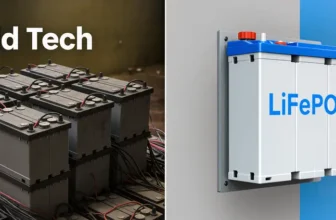
The distinction between NMC and Lithium Iron Phosphate (LFP) begins with elemental composition. NMC uses Nickel, Manganese, and Cobalt in its cathode structure, creating a high-density configuration capable of storing significant energy within a compact case. This chemistry has been refined extensively through the electric vehicle industry, resulting in consistent supply availability, predictable quality control, and proven durability across millions of deployed cells.
LFP uses an iron-phosphate structure. It is heavier for the same storage capacity, bulkier per kilowatt-hour, and takes more physical volume to support equivalent performance. LFP systems generally offer longer cycle life, but the difference has narrowed due to modern NMC improvements. Energy density remains the dividing factor. When homeowners need a slim wall-mounted battery or a system that integrates into constrained spaces, NMC provides a more efficient footprint.
Thermal and voltage profiles also differ. NMC systems deliver higher nominal voltage per cell, supporting high-voltage home battery configurations that integrate directly with hybrid inverters. LFP is chemically stable but less dense, leading many space-restricted homes to adopt NMC for practical installation reasons. The density advantage is the central driver behind the widespread residential adoption of NMC solar storage.
Finding the Best NMC Lithium Batteries for Home Solar Systems
The search for the best NMC lithium batteries for home solar systems begins with understanding depth-of-discharge capability. An NMC solar battery regularly supports 90% to 100% usable capacity. Lead-acid systems rarely exceed 50% without shortening lifespan. With NMC, homeowners obtain more usable energy per cycle, which matters in daily-cycling solar households. High DoD ratings reduce wasted capacity and increase real-world storage efficiency.
Compactness becomes the next filter. Because NMC achieves high watt-hours per kilogram, manufacturers can build narrow, wall-mounted units that resemble modern appliances rather than industrial equipment. This allows placement in garages, utility rooms, or exterior enclosures without consuming floor space. Systems such as the widely adopted LG Chem models or similar battery units maintain consistent form factors designed for small areas.
Round-trip efficiency is another core metric. High-quality NMC batteries return a large percentage of stored energy back into the home during discharge. This matters when solar panels charge the system every day and energy flows repeatedly through the battery. Low-efficiency systems create cumulative losses. High-efficiency NMC equipment reduces waste and optimizes daily storage cycles.
Evaluating discharge profiles, installation constraints, compatibility lists, and manufacturer specifications leads to practical system selection. The best systems maintain stable voltage behavior, tight thermal control, and verified inverter integration.
Analyzing NMC Solar Battery Prices for Residential Energy Storage
Understanding NMC solar battery prices for residential energy storage involves more than comparing upfront cost. NMC units carry higher initial pricing than lead-acid and often higher pricing than LFP, but long-term cost per cycle tells the relevant story. Because an NMC solar battery supports deep discharge, high efficiency, and long operational life, the cost per usable kilowatt-hour over its lifespan becomes competitive.
Price evaluation requires calculating cost per delivered kilowatt-hour rather than cost per unit. High DoD capability means an NMC solar battery yields more usable energy daily. High energy density reduces installation requirements. High-voltage output simplifies pairing with hybrid inverters that support closed-loop communication.
Most NMC home systems are rated in kilowatt-hours rather than amp-hours. This aligns with inverter specifications and helps homeowners size systems more accurately. A residential solar system may require storage capacity between 10 kWh and 30 kWh depending on usage, backup requirements, and panel configuration. The higher density of NMC lowers the physical footprint needed to reach these capacities.
Voltage requirements matter. Many NMC systems operate as high-voltage stacks. They require compatible hybrid inverters engineered to communicate directly with the battery’s internal Battery Management System. Systems purchased without verifying voltage and communication compatibility create inefficiencies or operational errors.
When price is analyzed through total delivered energy and system requirements, NMC maintains long-term cost efficiency for homes needing compact and high-output storage.
How To Buy NMC Lithium Ion Batteries for Off Grid Solar
Users evaluating how to buy NMC lithium ion batteries for off grid solar must start with inverter-battery communication. NMC systems do not behave like open-loop lead-acid banks. They require closed-loop integration between inverter and Battery Management System. This means homeowners must select batteries certified for the specific inverter brand they plan to use. Mismatched equipment will not deliver accurate voltage control, charge limits, or thermal protection. Without proper communication, the inverter cannot protect the battery or maintain stable cycling.
Shipping considerations follow. NMC units weigh less than equivalent lead-acid banks but are classified as Class 9 Hazardous Goods. Vendors use certified freight carriers, and buyers must plan for extended handling times, freight surcharges, or regional shipping exclusions. Installers must meet lithium installation qualifications, especially for high-voltage configurations.
Off-grid systems demand strong reliability. Homeowners must review manufacturer compatibility charts, firmware update procedures, warranty coverage, and cycle-life documentation. They should confirm that the chosen NMC solar battery is approved for off-grid operational profiles, which are more demanding than grid-tied daily cycling.
Correct procurement ensures safe integration, predictable behavior, and long-term reliability in remote or independent power systems.
Maintenance, Safety, and Thermal Management
Residential NMC systems rely heavily on thermal regulation. NMC chemistry produces strong energy density but requires structured thermal management to maintain safe operation. An NMC solar battery incorporates a Battery Management System that monitors cell voltages, module temperatures, current flow, and charge limits. The BMS prevents overcharging, overheating, and undervoltage conditions that could lead to cell damage or thermal instability.
Thermal runaway risk is mitigated through temperature monitoring, current limiting, and automated shutdown protocols. The BMS activates restrictions the moment temperatures move outside designated thresholds. This ensures stable operation across daily cycles, high-load events, and variable environmental conditions.
Cold-weather behavior follows a predictable pattern. NMC chemistry discharges safely at low temperatures but restricts charging when temperatures drop below specified limits. Homes in colder climates must install batteries in insulated environments or use systems with integrated heaters. Manufacturers publish operational ranges, and installation should follow those requirements without exception.
Maintenance demands remain minimal. There are no fluids to refill, no corrosion points to clean, and no equalization cycles. Oversight centers on firmware updates, inverter communication logs, and ensuring adequate ventilation. The simplification of maintenance tasks is one reason NMC technology has scaled rapidly in residential use.
Understanding temperature behavior, communication requirements, and safety controls provides a complete foundation for operating an NMC system efficiently. NMC’s density, performance consistency, and proven engineering make it a strong fit for modern residential solar installations.